lesson 1 of 5
What pickleball is
The point of the game in doubles, how a rally works, and how you win points and games.
Meet pickleball
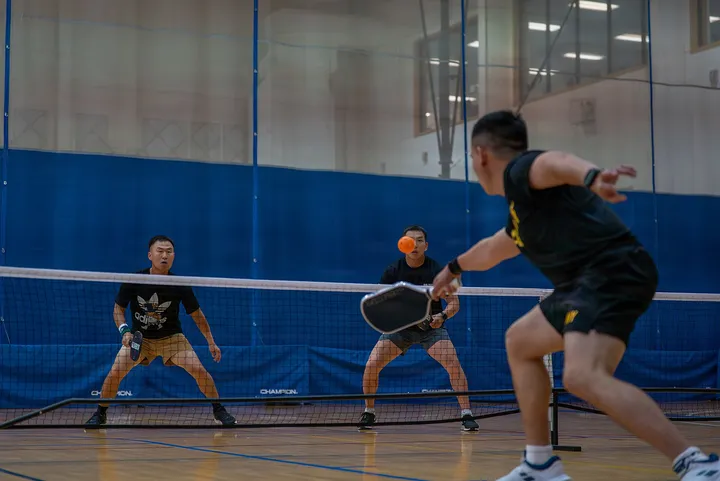
If you’ve ever played tennis, you already know the shape of it: two teams, a net, a ball going back and forth. Pickleball shrinks it all down. The court is so small that four of them fit on one tennis court, the net is lower, the rackets become solid paddles, and the ball is light plastic full of holes. The rallies are quick, close and social, and you’ll be in them from your first day. The goal is simple: land the ball where the other team can’t send it back. That’s the whole game. The rules are mostly about when you’re allowed to hit the ball, and where you’re allowed to stand when you do.
These lessons cover doubles, which is how most people play. Singles uses the same court and almost the same rules; it will get its own lesson later.

The goal: win rallies
Every point starts with a serveServeThe shot that starts every rally, hit from behind the baseline diagonally into the opponents' service court. In doubles each server gets one attempt.Glossary and turns into a rallyRallyEverything from the serve until the ball is dead: the shots back and forth until one side commits a fault.Glossary: the ball goes back and forth until one side makes a mistake. That mistake is called a faultFaultAny rule break that ends the rally: a ball hit out or into the net, a missed bounce, a volley from the kitchen, a bad serve. A fault by the receiving team gives the serving team a point; a fault by the serving team costs them the serve.Glossary, and it ends the rally. The most common ones:
- hitting the ball out of the court or into the net,
- letting the ball bounce twice on your side,
- volleying a ball you were not yet allowed to volley.
Here is how the start of a rally looks. The top team is serving.
- P1 serves from behind the baseline, on their right-hand side, and hits diagonally across the net.
- The serve lands in the service court diagonally opposite. P4 has to let it bounce before hitting it.
- P4 returns the ball deep and moves forward. Now P1's team has to let the return bounce too.
- Both bounces have happened, so from here on anyone may hit the ball out of the air. The rally goes on until someone faults.
Those two required bounces, one on each side, are the two-bounce ruleTwo-bounce rule also double-bounce ruleAfter the serve, the ball must bounce once on each side before anyone may volley: the returning team lets the serve bounce, and the serving team lets the return bounce.Glossary. It is the rule that makes pickleball feel different from tennis: nobody can rush the net and put the ball away straight after the serve.
Where it is played
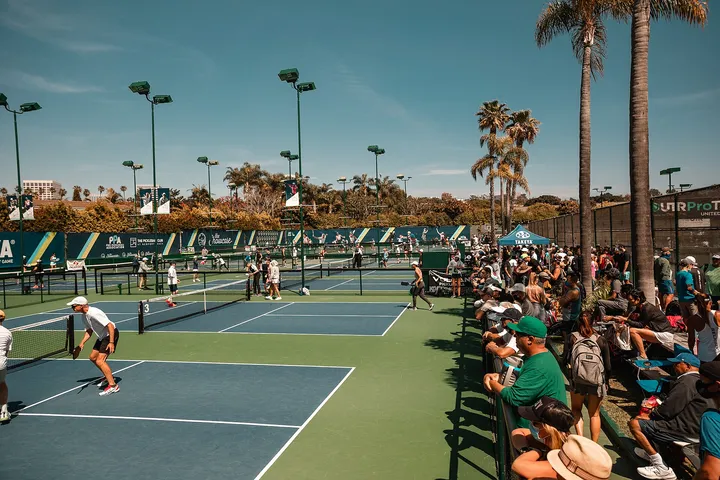
Almost anywhere. Pickleball is played outdoors and indoors, in every season, and there’s a court closer to you than you might think:
- Public courts at parks and rec centers, often free or a few dollars to play.
- Pickleball clubs, built just for the game, with leagues, lessons and open play.
- Tennis clubs that have added pickleball courts or lines next to their tennis courts.
- Private courts at homes, apartment complexes and communities.
Don’t be shy about asking to play. The pickleball crowd is famously welcoming to beginners. Walk up, say it’s your first time, and someone will lend you a paddle, show you where to stand and put you in the next game.

Winning points and games
- Only the serving team scores. If the receiving team faults, the serving team wins a point. If the serving team faults, they lose the serve instead.
- Games usually go to 11, and you have to win by 2. At ten all you keep playing until one team is two points ahead. That’s the most common game, but not the only one: tournaments often play to 15 or 21, and busy open play sometimes goes win by 1, so the next group gets on court sooner. Agree on it before the first serve.
- Both partners get a turn to serve before the serve passes to the other team, except at the very start of a game.
Win the rally and you might win a point. Serve and win the rally, and you do.
The score is called out loud before every serve, as three numbers. It sounds strange at first; a later lesson, The basic rules, explains how to call it.
Why play pickleball
It’s social. Four people a few steps apart on a small court talk, laugh and call the score all game. At open play you rotate partners after every game, so you leave knowing more people than you came with. Games are short, so there’s always a next one.
It’s good for you. Quick steps, short sprints, lunges and fast hands: it’s a real workout, but the small court means no long runs, so you can keep playing for an hour or two.
It grows with you. On your first day you’ll rally. Keep going and there’s always a next level: skill ratings, club ladders, local tournaments, all the way up to the pros. These lessons go from your first serve to 5.0.


What comes next
Before the rules make sense, it helps to know the names of the lines and areas of the court, because every rule refers to them. That is the next lesson.
check yourself
Quick quiz
4 questions on this lesson. Pick an answer to see if you're right, and why.
Only the serving team scores. If the receiving team wins the rally, they don't get a point; the serving team loses the serve instead.
Games are normally to 11, and you must win by 2. Tournaments sometimes play to 15 or 21, and busy open play sometimes goes win by 1 to keep the courts moving.
That's the two-bounce rule: the receivers let the serve bounce, then the servers let the return bounce. After that, anyone may volley.
A fault by the receiving team gives the serving team a point.
your score
– / 4