lesson 4 of 5
What you need to play
The paddle, the ball and the shoes, what the rules actually require, and what you can safely ignore when you are starting.
The whole list
Pickleball needs less gear than almost any sport: a paddle, a ball, and shoes you can move sideways in. Courts usually supply the net. That is the whole list.
What follows is what the 2026 USA Pickleball Official Rulebook actually requires, and then what actually matters on your first day, which is not the same thing.
The paddle
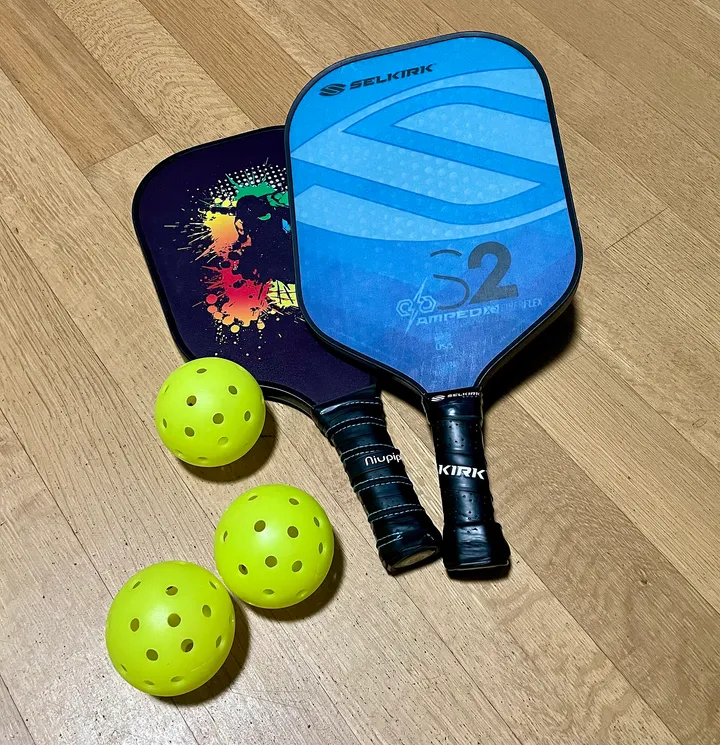

Borrow one first. Most courts have spares, and most players are happy to lend. You can’t tell what you want from a paddle until you’ve played enough to have a preference.
The rules, quickly: length plus width no more than 24 inches, length no more than 17, and no limit on weight or thickness. The face must be smooth: nothing added to grab the ball for extra spin.
Two approvals. You’ll see one or both stamped on a paddle:
- USA Pickleball Approved: tested against the official rulebook, and required at USA Pickleball sanctioned tournaments.
- U P A A certified: the pro tours’ own (the P P A Tour and Major League Pickleball), required in their pro divisions.
For open play at your local courts, neither matters: any normal paddle is fine.
When you buy, the only choice that will mean much early on is weight, and you can only judge it by holding a few. Heavier gives more power for less effort and tires your arm faster; lighter is quicker at the net. Everything else, from carbon faces to spin ratings, changes a game you don’t have yet. There’s a starter setup at the end of this lesson.
The ball
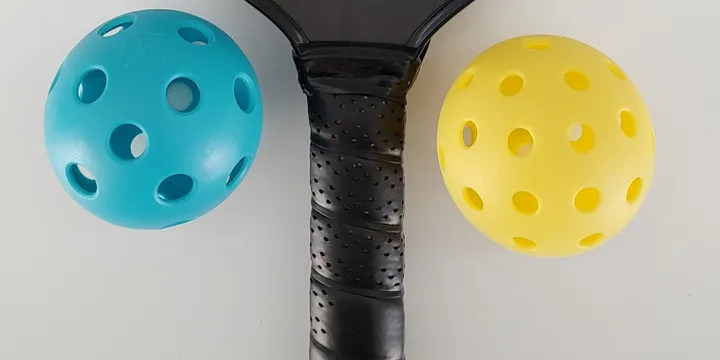

A pickleball is hollow plastic with holes in it. Two kinds are sold:
- Larger holes, customarily used indoors.
- Smaller holes, customarily used outdoors. The plastic is harder, so wind pushes it around less.
Note the word customarily. The rulebook says every approved ball is legal indoors or outdoors — the split is convention, because the outdoor ball copes better with wind and the indoor ball is softer and quieter. Play whatever the people at your court are playing with.
Outdoor balls crack, especially in the cold. This is normal, not a defect. A cracked ball goes dead and gets replaced mid-game without ceremony.
Shoes
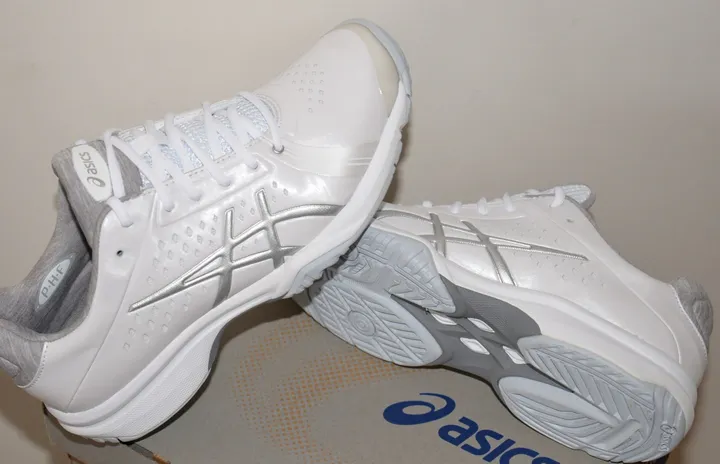

This is the one piece of gear worth getting right immediately.
Wear court shoes — tennis, squash, volleyball, or pickleball-specific. Running shoes are built for going forwards: soft, tall soles that compress and roll when you push off sideways. Pickleball is a sideways game played in a small space with sudden stops.
It is the most common thing new players get wrong, and the easiest to fix.
What you do not need
Not yet, and possibly not ever:
- A second paddle
- An overgrip, until the one on the paddle wears out
- A paddle bag
- Court shoes in a specific brand
- Anything that promises more spin
Turn up with a borrowed paddle and shoes you can move in. That is genuinely enough for your first month.
A starter setup
What to look for, rather than what to buy. Prices are rough US ballparks and move around.
Paddle — borrowed, or around $50–100. Look for: a USA Pickleball Approved stamp on the face, a 16 millimetre core (thicker cores are more forgiving and quieter than 13 millimetre), and a standard shape rather than an elongated one, which is easier to hit with while you are still finding the middle. Weight in the 7.8 to 8.3 ounce range suits most people starting out. Ignore everything else.
Balls — a three-pack, around $10. Get whichever type your usual courts use. Outdoor balls crack; buy a few.
Shoes — court shoes, around $60–120. Tennis, squash, volleyball or pickleball-specific all work. Any of them beats running shoes.
Then stop. Play for a month before buying anything else. You will have opinions by then, and they will be better than anything you can decide now.