lesson 5 of 5
Where to play
How to find courts near you, what open play is, and what actually happens the first time you turn up on your own.
Just show up
Pickleball is easier to walk into alone than almost any other sport. You do not need a partner, a membership, or a booking. You need a court and an hour.
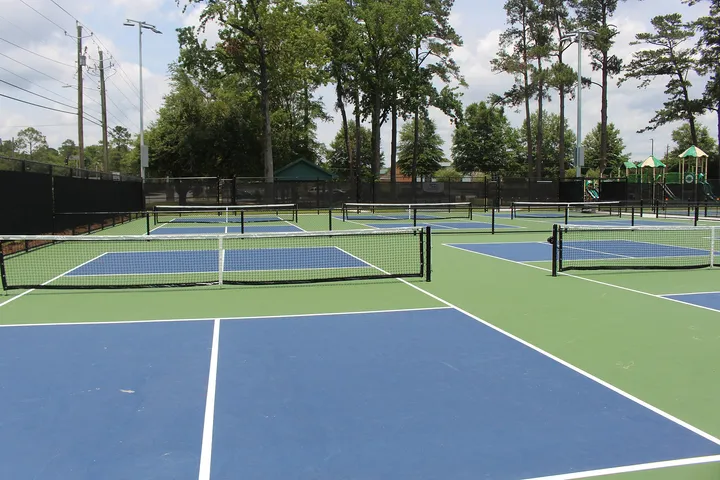

Finding courts near you
Start with the court finder. USA Pickleball partners with Pickleheads, which it calls the official court and game finder, and it is the fastest way to see what is near you, when open play runs, and whether the courts are free.
Then look locally. The finder does not know everything:
- Parks and recreation departments. Many cities run pickleball sessions that never make it into an app.
- Tennis courts with extra lines. A lot of courts are shared, with pickleball lines painted over tennis ones and portable nets in a shed.
- Community centres, YMCAs, churches. Indoor pickleball often lives in a gym on a weekday morning.
- Ask at the court. The players there know every venue within 20 miles and which nights are good.
What open play is
Most pickleball outside of leagues is open play: drop-in sessions where you turn up alone and play short games with whoever is there.
The usual shape of it:
- You add your paddle to a queue — a rack, a fence, a line on a bench.
- When your paddle reaches the front, you take the next court that opens up.
- You play one game, usually to 11, win by 2.
- Everyone comes off, and four new paddles go on.
That keeps games near 15 minutes and means you play with a lot of different people. The details vary by venue, so watch one rotation before you join it.
It’s all you need for a long time. Open play is the perfect way to play and improve right up to about the 4.5 level. Beyond that, most players move to private games: a regular group of players at their level, people they have met over their time playing.
Your first session
Turn up 10 minutes early and ask someone how the queue works. It is different everywhere and nobody minds explaining.
Say you are new. It is the single most useful sentence available to you. You get a partner who covers the middle, someone calling the score out loud, and a lot of patience. Claiming to be better than you are gets you into games you cannot enjoy.
Expect to play with everyone. Open play mixes levels by design. Some games will be too hard, some too easy, and you learn from both.
Do not worry about the score. Someone will call it. Calling it yourself comes later, and the rules lesson has it when you want it.
Indoors or outdoors
Both are real pickleball, and they play differently:
Outdoors you get wind, which pushes the ball around and makes the soft game harder, and sun, which is a genuine factor when you are looking up. The ball has smaller holes and harder plastic to cope with it.
Indoors is still, predictable and warmer, with a softer larger-holed ball that sits up more. It is easier to learn the soft shots in, and the lighting is never in your eyes.
Play whichever is closer. Most players end up doing both.
Apps and sites that find you a game
All of these are free, and all have a website as well as phone apps.
Pickleheads — the one to start with. USA Pickleball’s official court and game finder: courts near you, open play schedules, and local groups. Filter by indoor, outdoor, free, or lit.
PlayTime Scheduler — players post sessions and you join the ones at your level. Strong where it is established and thin where it is not, so check whether your area is covered before relying on it.
USA Pickleball places to play — the official hub, which also links the club and league finders.
TeamReach — not pickleball-specific, but a lot of local groups run their schedule on it. You join a group with a code, which is why you have to be told about it. Ask at the courts.
Main Court — matches you with players at your level, and lets you create a game and invite people to it. Built in San Diego and strongest there, though it is spreading beyond. If you are in San Diego, start here alongside Pickleheads.
The one that is not an app
Ask the people you just played with.
Every regular knows which venues are good on which nights, which group has space, and who to message. One conversation at the end of a session beats an hour of searching, and it is how most people find their regular game.