lesson 6 of 7
Moving as a team
Why two players at the line are a wall and one up one back is a gift, who takes the middle, and the three words that stop most collisions.
Two as one
Two 4.0 players who move together beat two better players who do not. Almost none of this is about shots.
You are joined by a rope
Picture a rope about ten feet long tying you to your partner. Not a suggestion — a constraint. When they move, you move.
If they get pulled wide to the sideline, you slide across with them. That feels wrong the first hundred times, because you are visibly abandoning the far sideline. Do it anyway: a ball down the outside line is a hard, low-margin shot, and the gap through the middle is an easy one.
Guard the space between you. The space beside you is somebody else’s problem to solve, and it is a harder problem than it looks.
Up together, back together
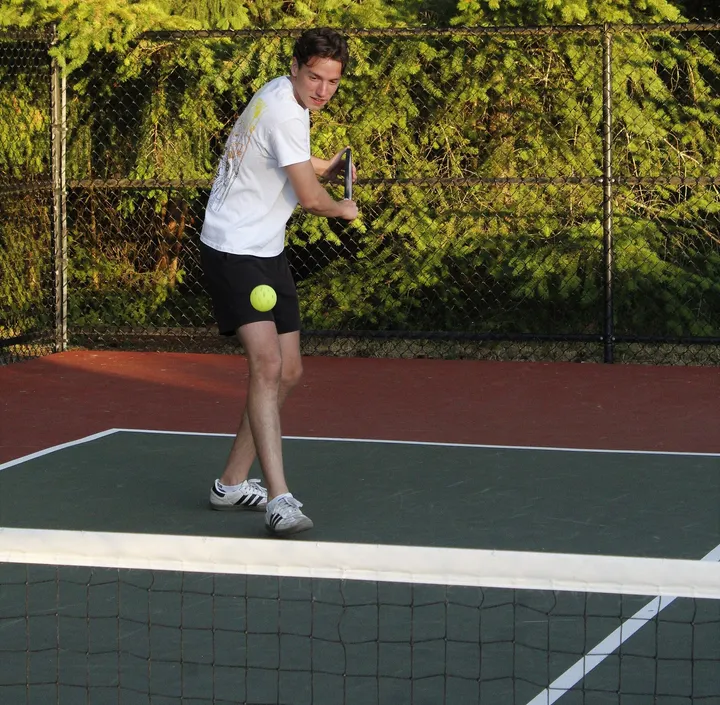

The two stable shapes are both at the kitchen line and both at the baseline. One up and one back is not a formation, it is an accident, and it opens a diagonal lane straight through the middle.
Which means: if your partner’s drop was short and they are stuck back, come back and join them. Standing alone at the line while your partner fights from the baseline looks committed and plays terribly — you have left a gap and you are about to get a ball at your feet anyway.
- Serving team pinned at the baseline, returners already at the line.
- The drop goes in and both players move — not just the one who hit it.
- They arrive together. There is no lane between them to hit into.
- Neutral, four players at the line. Nobody has an advantage, which was the whole goal.
Settle the middle before you play
The middle ball is where partnerships die: both of you go, or neither does, and it lands between you while you look at each other.
Agree a default. The common one is forehand takes the middle, because a forehand reaches further and hits harder. It matters far less which rule you pick than that you both know it before the first serve.
Then say it anyway. “Mine” and “yours” are the two most useful words on a pickleball court. Say them early — as the ball leaves their paddle, not as it arrives.
Three words that prevent most of it
“Mine.” Loud, early, and not negotiable once said.
“Switch.” When you have crossed over chasing something, so your partner knows which half is theirs now.
“Bounce it.” When a ball is going out and your partner is about to volley it. This one alone is worth several points a session.
That is the whole vocabulary. Partners who talk look like they have played together for years, and often they met twenty minutes ago.
What goes wrong
- Watching your partner play. While you admire their get, the ball comes back to the space you were supposed to be filling.
- Staying at the line alone because coming back feels like giving up. It is not; it is the shape that defends.
- Silent switching. Crossing over without a word leaves half the court empty and your partner in the wrong place.
- Two forehands going for the same ball. That is a rule you never agreed. Agree it in the warm-up.
check yourself
Quick quiz
4 questions on this lesson. Pick an answer to see if you're right, and why.
You move with them. The gap that matters is the one between you two, not the one by the sideline — so you shift across and let the outside line go, because a ball down the line is a much harder shot than one through the middle.
Agree it before the game and the hesitation disappears. Forehand-in-the-middle is the usual rule because a forehand reaches further and hits harder, but the important part is that you both know.
One up and one back opens a diagonal lane straight through the middle of the court, and it is the first thing a 4.0 opponent looks for. Better to drop back and be even than to stand alone at the line.
Default to the player it goes over chasing it, with their partner sliding across to cover. Switching mid-rally works too, but only if you say so — an unannounced switch leaves half the court empty.
your score
– / 4
take it to the court
Drills
- Odd one outThree players, two against one at the kitchen line. The pair may only hit into the single player's half; the single player can hit anywhere. Everyone keeps their own score.
- Earn the line togetherThree players. A feeder at the kitchen line feeds deep to a pair at the baseline, who have to drop, walk in level and reach the line together, then play it out two against one.
- Lone wolfA regular game for three: two against one. The lone wolf serves twice like a whole team, and the pair may only hit into the half the lone wolf served from.