lesson 2 of 7
The third-shot drop
Why the serving team hits a soft third shot, where to aim it, and how both players use it to reach the kitchen line.
The serving team’s problem
When your team serves, the two-bounce ruleTwo-bounce rule also double-bounce ruleAfter the serve, the ball must bounce once on each side before anyone may volley: the returning team lets the serve bounce, and the serving team lets the return bounce.Glossary pins you to the baseline for one shot. The returning team does not have that problem: they are already at the kitchenKitchen also non-volley zone, NVZThe 7-foot zone on each side of the net. You cannot volley while standing in it or on its line, and your momentum from a volley cannot carry you into it. You can step in to play a ball that has bounced.Glossary line by the time you hit. So your third shot is played from the worst position on the court against opponents standing in the best one.
That is the whole problem the drop solves.
Why soft beats hard here
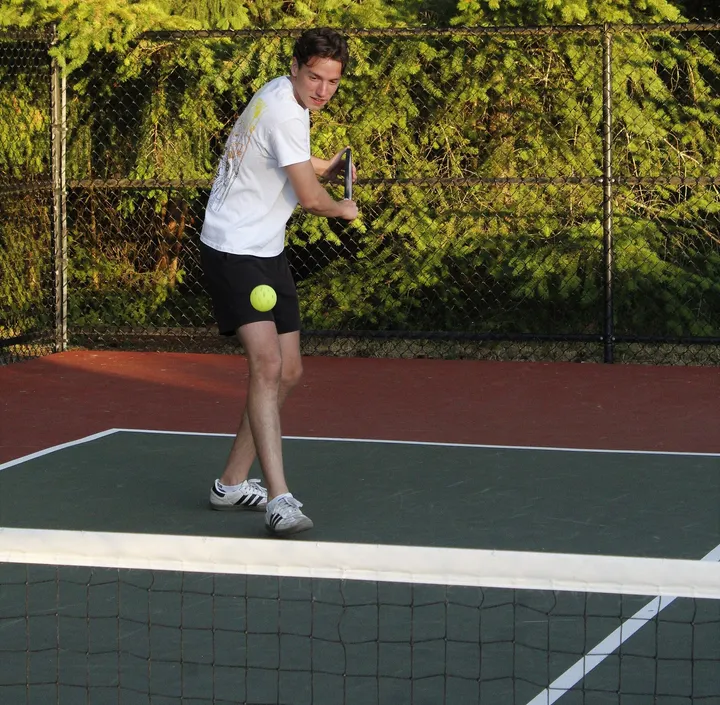
Drive the ball from the baseline and you hand a net player a volley while you are still 20 feet away from the line. Even a good drive usually comes back at your feet.
A soft ball that lands in their kitchen takes that away. They cannot volley it: it is below the net and dropping, so they have to let it bounce and lift it back to you. That lift is slow, and slow is what you need, because you are running forward.
- P1 hits the third shot from the baseline. The returning team is already at the kitchen line.
- A soft drop lands cross-court in the kitchen. P1 and P2 move up together while it is in the air.
- The opponent can only dink it back. P1 and P2 have reached the line.
- P1 dinks it back cross-court. The rally is neutral: nobody has the advantage yet.
Watch what the rally ends as: even. Nobody won anything. That is success. The serving team started at a disadvantage and erased it.
Where to aim
Where the drop lands
Into the middle of the kitchen, at their feet. Not at the line. A drop that lands two feet inside the kitchen is just as unattackable as one that kisses the line, and it does not cost you a point when you miss by a foot.
Cross-court, when you have the choice. The court is longer that way, so you have more room for error, and the net sags to 34 inches in the middle.
At the player who is back, if one of them is. If somebody hasn’t reached the line yet, make them hit the ball.
The only bad drop is the one in the net. Even a slightly high drop is recoverable.
Everything else keeps the rally alive. A drop that sits up gets attacked, but you can still reset or volleyVolleyHitting the ball out of the air, before it bounces.Glossary the reply. A drop in the net is a lost point with no chance of anything. So when in doubt, give it a little more height, not less.
The technique
A drop is a lift, not a hit. The pace comes from your legs and a long, slow swing, never from your wrist.
- Get low. Bend your knees so the paddle starts below the ball.
- Open the face a little, so it points up toward the net.
- Hold it loosely. A tight grip sends the ball long; a loose one lets the paddle absorb it.
- Swing from the shoulder, low to high, with no wrist flick.
- Finish toward your target, paddle out in front, and you are already moving forward.
In the minute below, Ben Johns, the best men’s player in the world, shows the drop. Watch where his paddle starts and where it finishes.
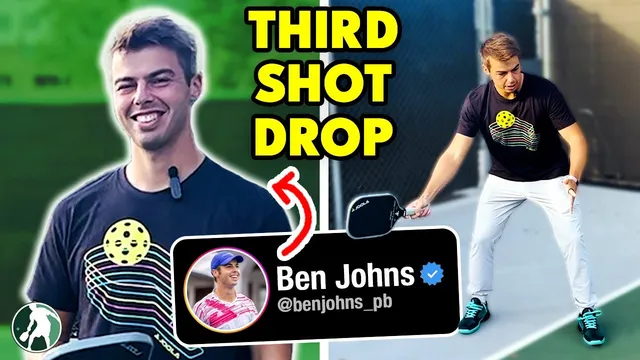

The third-shot drop in a minute
0:59Shots
The Pickleball Clinic: “World #1 Ben Johns Teaches the Third Shot Drop!”
why watch it A minute long, from the best men's player in the world. If you watch one thing about the drop, watch this one.
Follow your drop in
Hitting a good drop and staying at the baseline wastes it. The shot’s job is to buy ground, so take the ground:
- Hit, then move forward while the ball is travelling.
- Split-step before they make contact, wherever you have got to.
- Play the next ball from there. If it is low and hard, reset it into the kitchen. If it is high, take it out of the air.
- Repeat until you are at the line.
You will often need two shots to get there, sometimes three. That is normal and it has a name at 4.0: the fifth shot is just another drop.
Go together. Two players at the line is a wall. One up and one back leaves the middle open, which is exactly where a 4.0 opponent will hit.
What goes wrong
- Trying to win with it. The drop is not a weapon. Aim for boring.
- Watching your own shot. Hit and move. Admiring it costs you the three steps that make the difference.
- Running through their contact. Being caught moving is worse than being caught deep.
- Only ever drop. If the return is short and sits up, a drive can be the better ball: hit it and follow it in. The next lesson covers choosing between them.
check yourself
Quick quiz
5 questions on this lesson. Pick an answer to see if you're right, and why.
The drop is a travel ticket, not a winner. If it lands soft and you get to the line behind it, it did its job.
The only bad drop is the one in the net. A high one gives them a ball to hit; a netted one gives them the point.
Move while the ball is in the air, and stop in balance before contact. Moving through their contact is how you get hit at your feet.
Aim for the middle of the kitchen. Trying to paint the line adds risk for no reward: what matters is that the ball lands low and soft.
You will often need two drops to get to the line, sometimes three. A low ball at your feet can't be attacked, so hit another soft one into the kitchen and take a few more steps behind it.
your score
– / 5
take it to the court
Drills
- The 7-11 drillThe mini-game that makes the transition zone worth playing: the baseline player needs 7 points, the kitchen player needs 11.
- The drop bucketFeed yourself and drop into a hoop just inside the kitchen. Five in a row from the baseline, then from mid-court, then from the transition zone.
- Drop ladderOne feeds from the kitchen line, the other drops, moving up a step after each good drop and back a step after each bad one.
- Earn the line togetherThree players. A feeder at the kitchen line feeds deep to a pair at the baseline, who have to drop, walk in level and reach the line together, then play it out two against one.