lesson 3 of 7
Drive or drop
The third shot is a choice, not a habit. How to read the return you actually got and pick the shot that fits it.
The return decides the third
The serving team has two ways to get to the kitchen line: the drop and the drive. Both work on the third shot and on the fifth, and good players use both. Neither is the default. The return decides which one you hit, and you don’t know what the return is until it arrives.
Two shots, two jobs
- P1 serves. P3 waits at the kitchen line; P4 receives from the baseline.
- The serve, deep and cross-court. P1 and P2 stay back: the return has to bounce.
- P4 returns deep to P1 and walks to the line. The return is going to P1, so P2 takes a step in.
- The third is a drive, low at P4 as P4 arrives at the line. It isn't meant to win the point, only to get a weaker ball back.
- P4 blocks it, but it lands mid-court instead of in the kitchen. P1 steps in, level with P2.
- The fifth: a ball like that is easy to drop. P1 drops it into P4's kitchen, and both walk in behind it.
- From below the net, P4 can only dink it back. P1 and P2 reach the line together.
- All four at the line. The drive bought the easy drop.
The drop buys ground. It goes soft into their kitchen so they cannot hit down on it, which gives you the slow ball you need to walk forward behind.
The drive buys a mistake. It goes hard and low at a player, hoping for a block that pops up — and you have to be moving in to punish the pop-up, or you get nothing from it.
One is about position. The other is about pressure. Which one is better depends on the moment: the ball you get, how well your opponents handle a hard ball, where they are standing, and how well you hit each one.
Let the return choose
Here’s a simple way to decide. It isn’t a golden rule, but it will make you more consistent, especially at the 4.0 level. Look at the return and read two things about the ball:
How deep? A return that lands near your baseline pushes you back. From back there, the net is far away and everything has to travel upward — drop.
How high? A return that sits up around your waist inside the baseline is the ball you can hit flat and hard — drive.
Deep and low: drop. Short and high: drive. Everything else: drop.
Not sure? Drop it. A drop that goes wrong usually still gets over, and you can fight on. A drive that goes wrong tends to end up in the net.
Hitting the drive
A good drive is hard, but it isn’t flat. It has topspin, so it clears the net low and dips down instead of sailing long. Ben Johns’ keys:
- Power from your hips, not your wrist. Twist your hips through the ball. The wrist is fast but inconsistent: lean on it and your drives come off at different heights.
- Closed stance. Turn sideways to the net before you hit. Open stance makes it much harder to use your hips.
- Paddle face slightly closed, swing low to high. A flat face with a rising swing sends the ball up; close it a little more than feels natural.
- Hit the outside of the ball (the third away from you). Getting around it is what creates the topspin.
- Stay low and take it at the top of the bounce, arm reaching away from your body, rather than letting it drop.
To take pace off, close the face more instead of swinging softer.
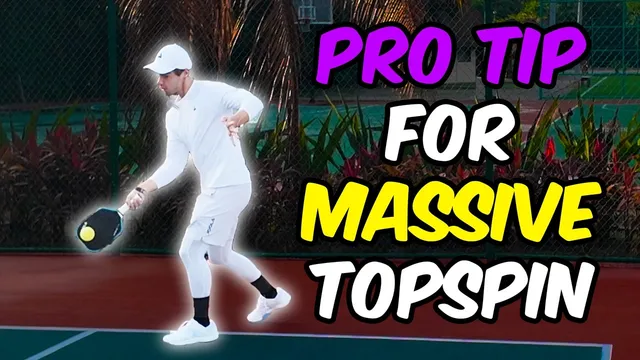
The topspin drive
14:38Shots
Josh J Pickleball: “How to Hit Topspin Drive in Pickleball with Ben Johns”
why watch it Ben Johns coaching a strong player's drive in real time: power from the hips instead of the wrist, a closed face and hitting the outside of the ball. You watch the drives go from flat to dipping.
The drive only counts if you follow it
A drive you hit and admire from the baseline has done nothing except give them a ball while you stand 20 feet from the line.
The whole point is the sequence: drive hard at a body, they block it up short, and your partner — already moving — puts it away. That is the shake and bake, and it works because two people committed to it.
- P1 serves. P3 waits at the kitchen line; P4 receives from the baseline.
- The serve, deep and cross-court. P1 and P2 stay back: the return has to bounce.
- P4's return sits up and lands short, so P1 steps in to it. P4 walks to the line; P2 takes a step in.
- A return like that is the one to drive. The third goes hard and low at P4's body, and P2 crashes the net behind it.
- Rushed, P4's block pops up weakly over the middle: the whole point of driving it.
- P2 was already moving, and puts it away into the open court.
Where to aim each one
The drive goes at a person. If one of them is still back, drive at that one: they are the furthest from the net and the most likely to send up a weak reply. If both are at the kitchen line, aim at the hip on one player’s paddle side. A gap gives them room to swing; a body does not.
The drop goes at their feet in the kitchen, cross-court when you have the choice, because the court is longer that way and the net is lower in the middle.
Neither one goes down the line into a player who is already at the kitchen line. That is the shot that comes back fastest.
What goes wrong
- Deciding before the return lands. If you have chosen your third shot while the ball is still on their paddle, you will hit the wrong one about a third of the time.
- Driving from too deep. A low ball from behind the baseline has to go up to clear the net and then still come down in. That is not aggression, it is hope.
- Driving alone. If your partner has not moved, the block comes back into space and you have handed them the rally.
- Only ever dropping. If you never drive, a 4.0 returner will hang at the line and take your drop early. The drive exists to make them honest.
check yourself
Quick quiz
4 questions on this lesson. Pick an answer to see if you're right, and why.
The return decides. A deep return that pushes you back is a drop; a short one that sits up is a drive. Picking before the ball arrives is how you end up hitting the wrong one.
A drive you do not follow is a free ball for them and nothing for you. The drive earns its place by forcing a block you can pounce on — and you have to be close enough to pounce.
A high, short ball is the one the drive was made for: you can hit it hard and flat from inside the baseline. Dropping this one wastes the only easy ball you were given.
A drive from behind the baseline off a low ball has to travel up to clear the net and then still land in. That is a low-percentage shot dressed up as an aggressive one.
your score
– / 4