lesson 4 of 7
The transition zone
The strip between the baseline and the kitchen where most 3.5 points are lost. How to cross it in pieces instead of running through it.
No man’s land
The transition zone
There is a strip of court between the baseline and the kitchen line that everybody has to cross and nobody wants to stand in. That is the transition zoneTransition zoneThe area between the baseline and the kitchen line. Players moving through it are easy targets for balls hit at their feet.Glossary, and more 3.5 points are lost there than anywhere else on the court.
Why it is the worst place to stand
It is not a rule. You can volleyVolleyHitting the ball out of the air, before it bounces.Glossary anywhere outside the kitchenKitchen also non-volley zone, NVZThe 7-foot zone on each side of the net. You cannot volley while standing in it or on its line, and your momentum from a volley cannot carry you into it. You can step in to play a ball that has bounced.Glossary. It is geometry.
A ball that lands at your feet in the middle of the court is below the level of the net, so your reply has to travel upward to get over. A ball travelling upward arrives at a player at the kitchen line above their waist — which is the ball they have been waiting all rally for.
At the baseline the ball bounces up to a comfortable height. At the kitchen line you take it before it drops. In between, you get neither.
The transition zone is survivable when you are still, and punishing when you are running.
Cross it in pieces
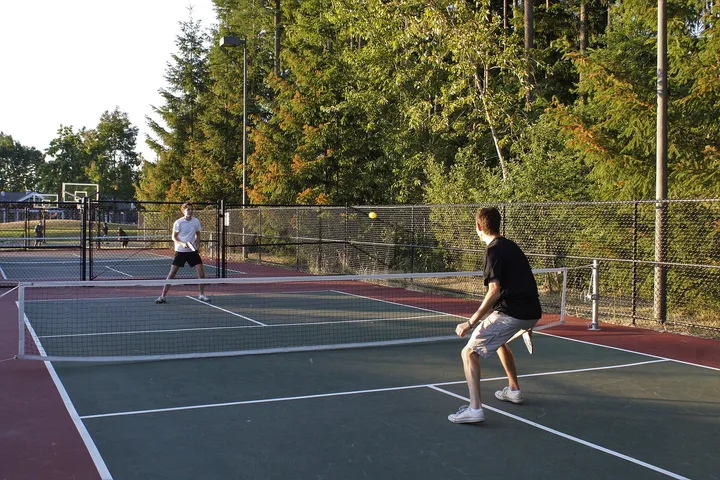

The mistake is treating it as a sprint from A to B. It is a series of short trips, and each one is paid for by a ball:
- Hit a ball they cannot attack.
- Move while it is in the air — two or three steps, not a charge.
- Split-step before they make contact, wherever you have got to.
- Play the next ball from a balanced stop.
- Repeat until you are at the line.
Two or three trips is normal. Arriving on the third ball, balanced, beats arriving on the first ball off your heels.
The shot that gets you through
The reset is the transition zone’s one required skill: a soft ball, hit off a fast one, that lands short and low in their kitchen.
The technique is mostly not technique. Paddle out in front, loose grip, no backswing — you are absorbing pace, not adding it. If you swing at it, it goes long.
A reset does not win anything. It buys you the slow ball you need to take two more steps, which is the only thing you wanted.
What being caught looks like
- P2 is at the line. P1 is at the baseline with a deep ball coming.
- The deep feed. Nothing wrong yet.
- P1 drives and runs in behind it — one long trip instead of two short ones.
- P1 is stopped nowhere in particular with a ball at their ankles. P2 did not have to move.
Notice that the mistake was not the driving. It was covering the whole distance on one ball, which left P1 standing in the worst part of the court with no time to do anything about it.
What goes wrong
- Running through their contact. If both feet are off the ground when they hit, you cannot change direction. Stop first, always.
- Backing up. Once you are past the baseline, retreating gives up everything you paid for. Hold your ground and reset.
- Swinging at the reset. The ball is already fast. Take pace off, do not add it.
- Standing still because you are scared of it. The transition zone punishes people who stop in it permanently, not people who pass through it. Waiting at the baseline is its own way of losing.
check yourself
Quick quiz
4 questions on this lesson. Pick an answer to see if you're right, and why.
You can volley anywhere outside the kitchen. The problem is geometry: a ball landing at your feet in the middle of the court is below the net and has to go up, and up is what they are waiting for.
Split-step before their contact, wherever you have got to. Being caught mid-stride is worse than being caught deep, because you cannot change direction with both feet off the ground.
A reset takes the pace off and lands short and low, which gives you the slow ball you need to take another step or two. Blocking it deep gives them another ball to hit at you.
You go as far as each ball earns you and no further. Trying to cover it in one run is how you end up arriving off balance, which is worse than arriving late.
your score
– / 4
take it to the court
Drills
- The 7-11 drillThe mini-game that makes the transition zone worth playing: the baseline player needs 7 points, the kitchen player needs 11.
- Shadow the transitionNo ball. Split-step at the baseline, three steps in, split-step, three steps in, split-step at the kitchen line. Ten times, as quiet and balanced as you can.
- FirefighterOne player at the kitchen line speeds up at the feet of the other, who stands in the transition zone and has to reset into the kitchen. Ten balls, then swap.